Kitchen Appliances
Appliances have become disposable. Today, most ovens, dishwashers, and refrigerators are built to last about 10 years, a sharp decline from the 80s and 90s, when the standard was closer to 20. Many don’t make it to year 10 without some level of mechanical problems, and replacement is often cheaper than repair.
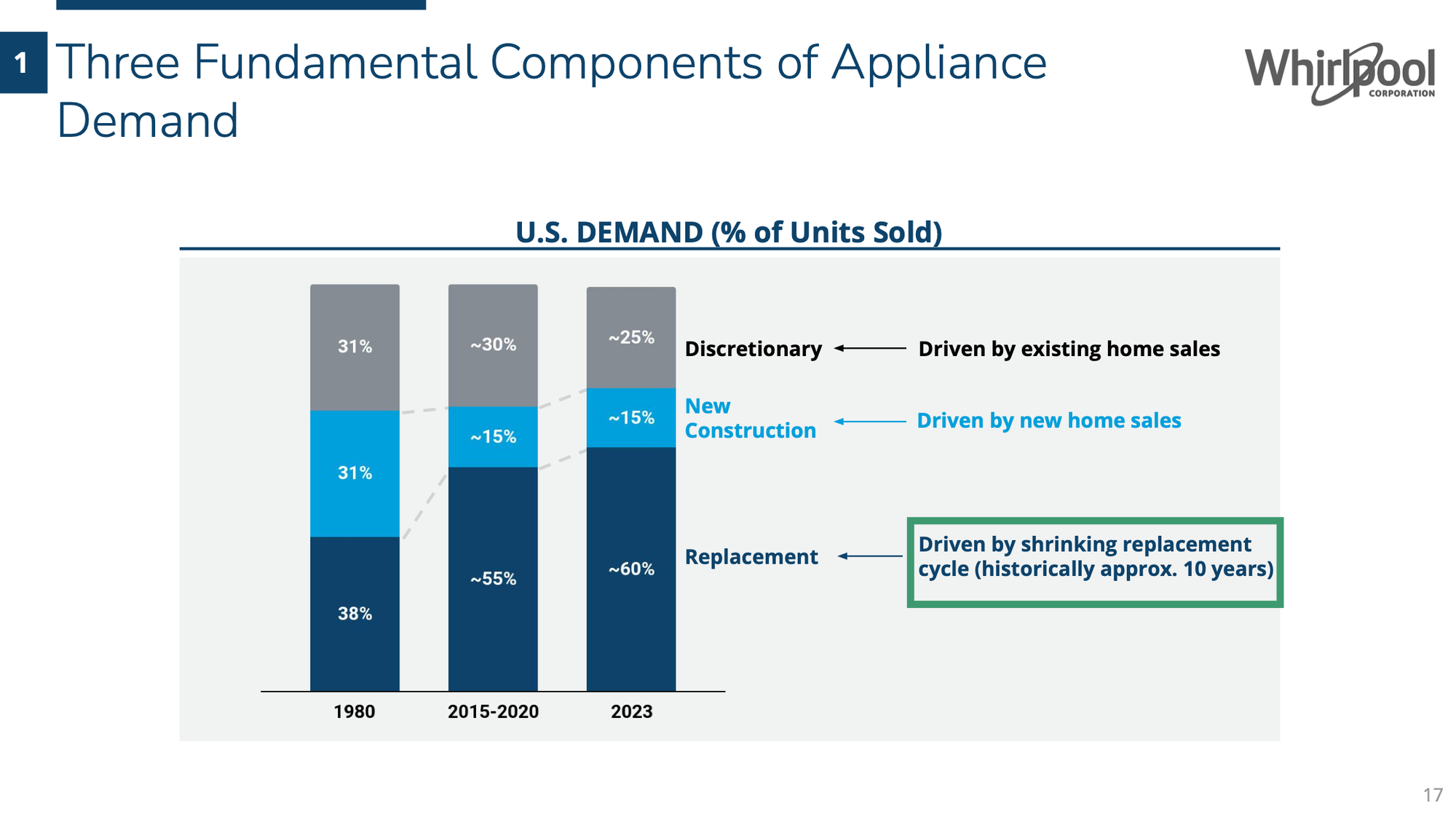
A 2025 study found that the average lifespan of ovens fell 39%, from 23.6 to 14.3 years, with the sharpest declines occurring in the 1990s and early 2000s. It is explicitly cited in Whirlpool’s 2024 Investor Day presentation: a “shrinking” 10-year appliance lifespan is among three fundamental drivers of appliance demand. A 2024 Wall Street Journal report described worsening reliability, even in high-end products.
The erosion of appliance durability reflects contemporary consumer product trends. Many contemporary appliances are built with some combination of electronic complexity, outsourcing, rebadging, excess use of sensors, and cheaper materials. Standard brands like Whirlpool, GE, Frigidaire, LG, or Samsung are built to last anywhere from 5-10 years before a cost-prohibitive repair is needed. On the high end of the market, some appliances still last closer to 20-25 years.
Companies outsource to reduce safety risks, avoid investment in new platforms, and meet customer demand for full product suites. Safety concerns are as old as the industry itself, and may have arisen with the first home refrigerators. Reliability is another risk inherent to developing in-house platforms. Following a large expansion in product offerings, Viking suffered severe declines in product durability in the late 2000s and early 2010s. Sales halved from peak revenues of approximately $400M in 2006-2007 to roughly $200M by the time of its 2012 acquisition by Middleby.
Assessment of appliances should start with the value of the underlying technology. It remains true that high-end appliance brands generally last longer than the middle of the market, but only if the products themselves are not rebadged versions of lower quality products from unknown manufacturers.
These ratings avoid low-end appliance brands because most are roughly equivalent in quality and reliability. Brands such as KitchenAid and Bosch are included because they sell in both the middle and high ends of the market. The ratings avoid the many cheaply built Chinese imitators on the market, including Thor, Forno, or Z-Line. These poorly engineered products have spotty service networks and are untested over the long-term.
Evaluation Criteria
- Ownership Structure: Family-owned and privately held appliance companies are generally better aligned with long-term product quality and customer service. Publicly traded and private-equity-owned companies face pressure to cut costs and expand margins, which can come at the expense of quality over time.
- Product Release Cadence: New product or platform launches almost always come with quality problems and can be difficult to service initially. Longer product cycles indicate careful R&D, testing, and manufacturing experience. Product cycles shorter than three to five years invite greater risk of failure, complexity, and repairability issues.
- Manufacturing Model: In-house manufacturing is a sign of consistent quality control, reliability, and parts availability. Outsourced manufacturing can introduce variability in quality, reliability, and repairability.
- Product Line Authenticity: Rebadging makes it difficult to identify the true manufacturer and often leads to lower-quality products of unknown origin. It is an easy way for manufacturers to enhance margins by selling the same underlying product with a premium label.
- Electronic Complexity: Wi-Fi modules, cameras, touchscreens, and excess sensors can be unreliable and difficult to service. Given their relative newness, the long-term reliability of these systems remains an open question. This is weighed less against brands that design and manufacture these components in-house, where quality control and parts availability are more predictable. Miele has a credible track record building reliable appliances despite their complex electronic features.
- Reliability: A reputation for high service rates, short lifespans, and recurring quality problems.
- Service Network and Parts Availability: Even the best appliances need occasional service. Brands with thin service networks, fewer qualified technicians, or long lead times for parts make routine failures far more costly and disruptive. Samsung and LG have historically struggled with this.
Ratings
Tier 1
These are brands where the entire product line can be recommended. Tier 1 companies make almost all of their products in-house and have a proven track record of selling reliable, high-quality products.
Sub-Zero/Wolf
Sub-Zero/Wolf (SZW) makes some of the best appliances available on the market today. The company has been family-owned since its founding in 1945. SZW makes most of its parts in-house and emphasizes longevity in their manufacturing processes and designs, providing for a minimum of 20 years of use. They do not release new products frequently. SZW appliances are consistently among the most reliable on the market. Its service network is among the most comprehensive in the United States for a premium brand. The now-defunct Wolf Gourmet brand was manufactured by Hamilton Beach (HBB) and a rare example of outsourcing from SZW.
Miele
Miele makes some of the best-performing and longest-lasting appliances available. It has been family-owned since its founding in 1899 and outsources very few parts. Miele is known for manufacturing most components internally. Its M-Touch software is a reliable and well-engineered implementation of touchscreen technology. Service availability can be spotty outside major metropolitan centers. Product release cycles are long. Reliability is among the best in the industry.
SpeedQueen
SpeedQueen exclusively builds laundry equipment. The company is part of Alliance Laundry Systems (ALH), a commercial manufacturer of washers and dryers. SpeedQueen equipment is among the most reliable in the industry because it is engineered simply and uses commercial-grade parts designed for durability under heavy usage. Although the 2025 IPO of its parent company is concerning, SpeedQueen makes some of the best laundry equipment available.
True Refrigeration
Founded in 1945, True entered the residential refrigerator market in 2008, building on its legacy of manufacturing commercial refrigerators. The company manufactures all products in its Missouri facility and outsources very few component parts. True Residential releases refrigerators over long product cycles and is neither publicly traded nor owned by private equity.
Vent-A-Hood
Vent-A-Hood (VaH) was founded in 1933 and invented the first kitchen ventilation systems, which remain its only appliance product category. The company manufactures all of its products in Dallas. VaH does not outsource many parts and has an excellent reliability track record.
Tier 2
Tier 2 brands sell high quality products, but their entire lines cannot be trusted due to shared platforms, outsourcing, and rebadging. Most are reliable enough but may not last as long as Tier 1 brands. Purchasing from these companies requires research into the origin of specific products (e.g. a Gaggenau dishwasher that is really a rebadged Bosch at a ~$1,500 markup).
BSH Group (Gaggenau, Thermador, Bosch)
While generally good products, BSH offerings vary in reliability because they suffer from badge engineering. While Gaggenau’s EB 333 built-in ovens are unique in their excellent design, reliability, and performance, other BSH products share core parts with Bosch platforms that cost thousands less. Despite the name brand, many Bosch products are built to the same level of quality as Whirlpool or GE and are unlikely to last more than 10 years. BSH is known for its excellent induction technologies and sells the unique “Freedom” cooktop technology across its brands that allows pans to be placed anywhere on the cooking surface. BSH dishwashers are among the best available on the market.
BlueStar
BlueStar is part of Prizer-Painter Stove Works, founded in 1880. The BlueStar brand launched in 2002 after Prizer stopped manufacturing stoves for other brands, including Garland’s now defunct residential line. BlueStar builds on Prizer-Painter’s legacy of commercial manufacturing and metal fabrication. BlueStar remains family-owned and has historically developed products over long cycles. Its ranges are built in Pennsylvania. Its newer freestanding refrigerators are outsourced and its dishwashers are of unknown origin. BlueStar ranges typically feature industry-leading capacity, power, and commercial-grade durability.
Whirlpool (KitchenAid, Jenn-Air)
A mid-range offering from Whirlpool (WHR), KitchenAid sells rebadged Whirlpool products with premium features. Its built-in refrigerators are manufactured in-house by Whirlpool. Its ovens and other appliances are simply Whirlpool products with additional features and premium styling. Jenn-Air also sells rebadged Whirlpool/KitchenAid designs with higher-end finishes and some additional software features. Both brands are not engineered to last 20+ years, but are priced well below other premium brands. Service and parts are readily available.
Tier 3
Tier 3 appliance brands are almost universally rebadged and part of large, public companies that emphasize margin expansion through cost-cutting that impairs reliability and quality. Tier 3 products are usually built on shared platforms with either unknown or poor reliability.
GE Appliances (Monogram, Café, Fisher & Paykel, DCS)
GE is owned by Haier, a Chinese conglomerate. Its products feature novel technology and innovative features, but longevity is below average. Most product lines and parts are outsourced. New GE brands are released frequently and most rely on outsourced, complex electronic systems that are unlikely to age well. Haier employs extensive rebadging across its product lines.
Viking
Viking was a pioneer of the consumer-professional category, but has fallen far from its leading market position in the 1990s and early 2000s. Now a division of Middleby (MIDD), Viking suffers from consistently poor reliability, extensive rebadging, and frequent product releases. On the positive side, some products use commercial-grade technology, such as its rebadged Southbend open-burner ovens from Middleby’s commercial offerings. It is concerning that Middleby recently sold 51% of its residential business, including Viking, to a private equity fund.
Dacor
Once an innovator in the appliance business, Dacor has largely faded from relevance since its acquisition by Samsung in 2016. In past decades, Dacor would have been a Tier 1 company as founder Stanley Joseph's 1997 memoir, Adventures of a Salesman, emphasizes many of the same manufacturing and design principles that define the best appliances. Today, most Dacor products are laden with complex electronics shared with their cheaper Samsung cousins. Samsung manufactures appliances in-house but relies heavily on third-party suppliers, and has historically struggled with parts availability in the United States. Reliability has been inconsistent.
Signature Kitchen Suite (SKS)
SKS is LG’s luxury appliance suite. While its products include many innovative features, it’s too early to assess reliability and the extent of rebadging across the line. LG makes more component parts compared to other mass market brands, but its engineering emphasizes cost efficiency and rapid product release cycles rather than longevity. Like Samsung, LG parts have been difficult to obtain in the past and reliability remains an open question. ■